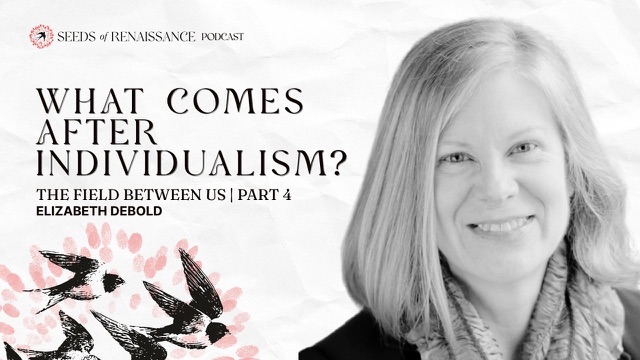
PodcastThe Field Between UsPart 4 of 4
Earth, Sky, Mortals, Gods: A Second Axial Age?
What Are We Standing On? Life After Individualism
Series intro
This is part of a four-part series with Elizabeth Debold on interbeing and emergent dialogue.
Elizabeth Debold, Ed.D., came to the late Andrew Cohen's EnlightenNext community at forty with a Harvard doctorate and a bestselling book, and found something none of it had prepared her for: a field of shared awareness that opened between eleven women on a retreat in 1999, then between thirty men in 2001. She was thrown out five times and kept going back. When the community collapsed she and her partner Thomas Steininger, who died in 2025, spent the years since asking what that field was and how to cultivate it without a guru. Four conversations with Rufus Pollock: the story, the practice, the ideas, and where it could lead.
This episode
Rufus opens by reading Kegan on the spiral of balance between separateness and connection, and Elizabeth’s claim that the next turn is towards integration without losing individuality. She calls that trans-individuation: being the chooser, and choosing to start from the wholeness you are already part of. Touching it, she says, calls you to your knees, not in a servile way, but in awe. There is also a kickback.
It calls you to your knees, not in a servile way, but in awe.
Rufus asks how a small group would actually decide something hard, like whether to keep running a residency space. Her answer is the most practical stretch of the series. First bring the field to life between you. Then Heidegger’s fourfold: Earth (what are we standing on, what history brought us here), Sky (what is uniquely possible for the people here), Mortals (we have only so much time and money, and what could be born), and the Divinities (what is good, true and beautiful in this). “We are the fourfold.” A dialogue doesn’t happen in me or in you; it happens between us.
A dialogue doesn’t take place in me or in you. It takes place between us.
Then the big claim, which she keeps conditional: the first Axial Age made us individuals; if this takes hold it could be the second. Small groups set the template. She closes on Thomas: writing the book as he was dying, Heidegger as his thinking partner, and his face appearing, she says, when she untied a knot he had seen first. “Our partnership is still very much alive.”
Chapters
- 00:00Kegan's spiral of balance: the reading
- 03:28Emergence is how the cosmos creates
- 13:22Trans-individuation: the chooser and the whole
- 18:17The kickback, and what calls you to your knees
- 26:00Fusion is not integration: the thunk
- 31:51A real decision: how would we sit with it?
- 34:17Earth, sky, mortals, gods: the fourfold
- 43:45A second Axial Age?
- 51:10Small groups set the template
- 56:39An interbeing ecosystem: the grand experiment
- 58:46Thomas: the book, Heidegger, still very much alive
Speakers
Elizabeth Debold, Ed.D., is a gender researcher, writer, and teacher who has spent four decades asking how women and men can grow toward freedom and equality together. She was a founding member of the Harvard Project on Women’s Psychology and Girls’ Development, co-wrote the bestseller Mother Daughter Revolution, and co-founded One World in Dialogue, a global network of people practicing deep dialogue.
Rufus Pollock is a co-founder of Life Itself, an entrepreneur, activist, and author, as well as a long-term zen practitioner.
Notes and links
Website: Evolve · One World in Dialogue
Upcoming event: The Rediscovery of the Sacred
Book: Mother Daughter Revolution: From Good Girls to Great Women (1993)
Transcript
Rufus Pollock (00:14) Okay, welcome back to this series with Elizabeth Debold and the practice of emergent dialogue and the emergence of interbeing. Welcome, Elizabeth.
Elizabeth Debold (00:29) Thank you, Rufus. It’s been a pleasure to explore this with you and to hear some of my favorite passages from my book read back to me.
Rufus Pollock (00:44) Well, that’s a perfect introduction, because I think today, in the last sessions we’ve been talking about what is interbeing and the role of emergent dialogue in cultivating this field between us and beyond us and through us. I wanted to start today with an extended quote from your book, because I think it really has the essence of why what you’re working on is so important and powerful. And it begins with a quote from Robert Kegan in your book. It says: the spiral of development is a spiral of balance. It is a spiral of balance between the need to be connected to others and the need to be separate from others. It is a spiral of balance between the need to be included in a larger whole and the need to be distinct from the whole. It is a spiral of balance between the need to be autonomous and the need to be dependent. And it’s a quote from his book, The Evolving Self. And you then say autonomy is the experience of differentiation whereby we become whole in ourselves, while connection and being part of a larger whole is the human experience of integration. This pattern of emergence in human life leads to some of the deepest experiences that human beings have. Individuational differentiation opens us to the inner world of the psyche, mystical depth experiences, and different forms of identity. Connection, or integration, brings us into ever deeper intimacy and relationship and a sense of being at home in the world, and ultimately a non-dual realization of the inherent and prior unity of all. And I think this is maybe the most crucial section of the whole book so far.
Elizabeth Debold (02:29) Mm-hmm.
Rufus Pollock (02:31) As should be obvious, if this pattern holds, then the next movement of the spiral will be towards integration and unity without losing individuality or creative autonomy. That’s because, as you’ve said, we’ve discussed quite extensively already, but just to recap, we’ve been through a massive wave of individuation in modernity. And what you’re saying here is that the next turn of the spiral is back towards integration. And this is the crucial role of emergent dialogue and the discernment of interbeing, or the cultivation of this field of interbeing. Can you say a little bit about emergence? You talk also in that section about emanation. Why is that, and what’s the role of emergence and emanation in this next turn of the spiral towards integration and this greater unity?
Elizabeth Debold (03:27) So emergence, I think I write this too: emergence is the way the cosmos creates. The capacity for emergence is the creative capacity of the cosmos from the beginning till now. It’s the ground-up shaping of life, so that it expands its capacity for autonomy, for depth, for, in human terms, knowing, loving, and being. Kegan and other developmental theorists have noted this kind of rhythm of separation and connection, or individuation and relatedness, but those dynamics are the dynamics of the separation we’ve referred to before. These become, in modernity, polarities: relatedness and individuation. And we’re at a point now, as we’ve said before, of a kind of hyper-individuation where emotional connection, a being-with, compassion, is increasingly difficult and increasingly fraught. And we see that in what we referred to before in terms of addiction, depression, the lack of stable relationships and families, and so on. But what’s happening now is an integration of this separateness and connectedness, which is what I’ve pointed to before. This next step is not a polarity any longer. It’s a step towards integration and autonomy at the same time. That’s what we call trans-individuation: the capacity to be in touch with the deepest part of ourselves that we share, and to be able to create from that wholeness, while maintaining one’s own capacity for choice. So we’ve had this ping-pong kind of effect up to the point where we are now, and the next step appears to be an integration of separation and connection.
Rufus Pollock (07:23) Mm.
Elizabeth Debold (07:26) So it’s kind of a meta-integration. It’s not just relatedness. There’s a different world here, a different capacity, a different reality that one is living in. It’s not “I’m related to you, and we’re having a relationship, we’re connecting, we’re communicating,” which is what we’re seeking, that kind of emotional connection. It’s that the whole field of being, of life, is now one where there is this depth of connection, this already-connectedness. And that’s an important point. A lot of people point to this as relationship, when instead we should think about it as the prior relatedness that we are.
Rufus Pollock (08:44) Yes. Can I ask, because I’m thinking about it, and it’s not a perfect analogy, but it’s to say: when we think of emergence, we can think of the moment when bacteria, which were maybe dying because oxygen was poisoning the atmosphere for them, became multicellular organisms. And in this moment, it’s not just like “oh, I get into a new kind of collaboration.” There’s a kind of new whole, a new
Elizabeth Debold (09:15) Mm.
Rufus Pollock (09:16) that emerges, the organism, of which they are a part, but which is also greater than them, and integrates them in this novel way. And so this is what we mean by emergence: these moments of profound shift, something kind of new that, in the old world, was impossible to really imagine. The bacteria in the old world maybe imagined, “I’m going to collaborate a bit more with someone.” Whereas what really emerged was something completely new. And this is this field of
Elizabeth Debold (09:45) Yeah, this is
Rufus Pollock (09:48) interbeing that’s emerging, that we’ve been talking about: that there’s something that could be emerging that wouldn’t be like “I’m going to collaborate more,” it’d be something, almost, unless you’ve experienced it, as you’ve been trying to point to, that we could talk about but we have to touch it. This field between us, between you and I, even right now, has its own intelligence. This is the emergence of something really new.
Elizabeth Debold (10:09) Yes, yes. Really new potentials. It has within it potentials for creativity, knowing, being, and loving that we haven’t seen before. This is the coming out of the goo state that we were speaking about a couple of sessions ago.
Rufus Pollock (10:43) Becoming the butterfly, as the caterpillar transitions through the imaginal goo into the next stage. That’s this moment
Elizabeth Debold (10:50) Yeah.
Rufus Pollock (10:50) that can be happening now, maybe, yes.
Elizabeth Debold (10:52) Yeah. And part of the reason I trust it so much is that this isn’t something that sprung, like Athena out of the head of Zeus, as some kind of theory that people are trying to implement. It’s not that intellectually, this way that autonomy and communion are integrated in interbeing is just not on the maps of our understanding of how human development works. And that is fascinating to me. It responds perfectly to the crisis that we’re facing. It starts with a ground of wholeness and a perception, a capacity to perceive wholeness: there’s the whole of myself, there’s the whole of right now, that in this context you and I, Rufus, constitute a whole, but then there’s something bigger than ourselves that we’re part of, and being able
Rufus Pollock (12:28) Mm-hmm.
Elizabeth Debold (12:29) to simultaneously hold these things and have a perception of them, and allow them, not intellectually but actually, in a more of, it’s simply the context that is real, that then brings in a completely different perspective on whatever it is that we’re exploring together or questioning or wondering about, that shifts the ground of life.
Rufus Pollock (13:21) I think then, to be the emergence, asks us to answer a question, again to quote from your book: can we step beyond our well-developed and well-protected individuality to become instruments of emergence for self and society? Can we consciously and collectively choose to go further, not to discard what we have, but to deepen and open into trans-individuation. So
Elizabeth Debold (13:53) Yeah.
Rufus Pollock (13:53) that’s another big word there that we
Elizabeth Debold (13:56) Yeah.
Rufus Pollock (13:57) should unpack later. So you coin this term, trans-individuation: going beyond individuation, the development of the individual, without losing it, transcending and including the separate self. Now what does a trans-individuated person look like in everyday life? Tell me more, what is this term, trans-individuation?
Elizabeth Debold (14:21) Well, it’s being simultaneously the chooser, that’s the individual, that we bring the power of choice to align ourselves with this deeper reality. And with that I mean: if we meet, on the plane or in the embodied recognition that we are not separate, that we are part of this life together, and then we want to speak about an argument we’re having, or we want to go into something we disagree on, starting from this other point rather than from my perspective and your perspective, starting from this wholeness that we are, and the preciousness that we experience in realizing that, and by that I mean giving it the status of reality, that it is, that we realize this wholeness by our attention to it as a trans-individuated human. And that realization reconfigures, it’s a new use of the term, reconfigures how it is that we go about thinking about the conflict we’re having, or the issue we’re dealing with, or the project we’re working on. It’s no longer about jockeying for position or competing. Out of this wholeness, new possibilities of connectivity and insight arise that are dramatic, that are based on a different demand from the reality that we’re in. If you’re separate and fighting for your life, a competitive position at work, or a project, or whatever it is, the things we deal with all the time: when you’re alone in that, and separate, you try to turn everything to your advantage. That becomes a sane thing to do. But
Rufus Pollock (17:21) Yes.
Elizabeth Debold (17:22) In interbeing, the field itself has wisdom that integrates, because it is a form of wholeness. The wholeness of the field is in co-creation with us, as we are in co-creation with each other, to synergize and integrate the perspectives that we have, the diversity of our experience. And it creates a space where it’s not, again, like we’re cooperating as separate individuals, it’s like we’re co-creating with the creative force of life.
Rufus Pollock (18:16) I’d like to ask, because even for myself, there must be some challenges in moving into this. Maybe I could ask, because of this kind of paranoia: even with the most sincere intentions, our efforts to transform ourselves and society are weighted by the past, into staying within its orbit, the current social imaginary of modernity, of individualism, offers us ways of being, knowing, and loving that no longer satisfy the soul’s desire for the good, the true, and the beautiful. Yet these ways of being human together are so familiar, they feel natural, just the way things are and should be. We can’t imagine that we could change what feels as close as our skin. But interbeing offers us a new way of being, knowing, and loving as humans together that opens up a new horizon of possibility: cultural transformation. So what I’m hearing is that everyone listening to this podcast, at least me, sitting here listening to you, we know what it feels like in the patterns of individualism. I’m alone, or even when I connect, I connect as me. What I want to ask you, though, is: so what I’m hearing then is that interbeing, when the field of interbeing is touched, that’s what’s taking us towards trans-individuation, this moment of transcending individualism, not by throwing it away, but by including it. But can you tell me about your own times of struggle, where it’s difficult? Because I think that resonates: you might touch this and then see your old habits again, or see competition or other things arise, or you even have this example of Andrew Cohen, who maybe wasn’t yet fully in this field, but where, seemingly, aspects of the old paradigm might have shown up. I guess what I’m asking is: what does it feel like to start stepping into this? Are there moments where one kind of pulls back? I think that would make it real for those who are only just first touching these things.
Elizabeth Debold (20:26) I would say all of it, Rufus, all of it. There can be, and I certainly experienced it, and anybody who’s had a deep experience of self-transcendence often knows that there’s a kickback. There’s often a big kickback. It’s like the patterns of self, and its motivations, and fears, the sense of “I have to be this way or else I’m going to get wiped out, or left behind, or not going to have a relationship,” or that soulmate thing, or whatever. But the thing that I find to be key is love, and what I mean by that, or care: there is a quality to this place of interbeing, there is an opening to Life itself in its creative pureness. And what’s engaging with interbeing for the first time: people often speak about being touched by something that is profound, that they don’t know exactly what it is. They speak about a tenderness, a sense of care. There’s a recognition of the preciousness of this, that seems to be a direct communication from the creative force of life. The creative force of life has created all of this, but the actual experience of it is of something quite precious and fragile, that you have to care for, that you want to take care of, because you experience that the essence of life is love, and in that recognition you’re motivated to give your best to it. And so it calls you to your knees, not in a servile way, but in awe. Like, wow, I know I’m touching something that is so precious and so delicate, and whether we make it as human beings may depend on this, on my connection with my sense of responsibility, and I don’t mean that as duty, but that I have to respond to this, that I’ve been shown. And that to me is the biggest motivator for letting go of your fixed ideas about who you have to be, letting go of your competitive nature, letting go of the need to grab things for oneself, because otherwise you’re going to miss the boat, or miss the next opportunity, or whatever. But it’s a learning process. At first, certainly, I think everyone, because we do this in language, and our language right now is so attached to the conceptual mind.
Rufus Pollock (25:21) Mm.
Elizabeth Debold (25:23) So we have a hard time speaking from this, or creating a context that evokes it, which is part of what we’re here to do as trans-individuated humans, in that making this transition is about aligning oneself with this deeper impulse of creativity that now becomes apparent to you.
Rufus Pollock (26:05) And you say here, again to quote: the practice of emergent dialogue enables us to experience microcultures of interbeing that open this shared space, but also begin to illuminate the capacities that individuals develop through interbeing. This is trans-individuation, which expands and deepens who we are without compromising our integrity as unique persons with the power to make choice for ourselves. The potential transformation marks a shift in the direction of our culture towards connection and integration. Now, you’re talking here, and you’re even coining the term trans-individuation, using Wilber’s kind of pre-trans distinction, like pre-rational, rational, transrational, pre-individual, individual, trans-individual. The transrational and the trans-individual re-enchant the world. But is there any kind of danger of people mistaking pre-individual fusion for actual trans-individuation?
Elizabeth Debold (27:05) Sure. And also people thinking that their individual goals and desires are what interbeing really wants. We’re, of course,
Rufus Pollock (27:21) Right. How have you seen that happen? And how do we skillfully develop that capacity in the collective field to discern that occurring?
Elizabeth Debold (27:38) Well, that’s cultivating one’s discernment. I think this is part of the reason why it’s so important to do this as a group. This is a collective practice. You don’t do emergent dialogue on your own. You don’t experience interbeing on your own either. Interbeing happens between us, and it happens through language. There’s a field that’s created between us, in a group that is speaking to each other. It could be about a project, it could be about the consciousness that’s opening up. We tend to start by reinforcing people’s perception of the field, so that there’s more and more sensing of what is and what is not.
Rufus Pollock (28:52) Could you give any kind of example, again obviously anonymous, where there was something coming up in the field where someone was maybe confusing their desires with what interbeing wanted, and the group was able to correct? I think this is a question that people, including myself, have had sometimes. It’s like, in the pre-fusional model where we’re actually just going backwards, there’s this aspect of like, we’re all kind of subserving into a field, and there’s the guru, or someone who knows what the truth is. And this is very different. I think you’ve really emphasized that throughout, and I get that, which is that we’re sensing together the emergence of this collective field that’s between us, through us. But then the quick question is: if we’re deciding, let’s say, we’re a group deciding what we’re going to spend money on, or whether we’re going to… I don’t know, right now, at Life Itself, we have a difficult choice about whether we continue running the residencies we’ve run.
Elizabeth Debold (30:02) Yeah.
Rufus Pollock (30:03) And it costs money, we’ve often, it basically loses money, but there’s also something really amazing about it that we’ve offered to the world. This is a really difficult decision within the group. So could you give any kind of vivid example where not only there was a choice we made, but maybe someone was confusing their needs with that of interbeing, and it was gently corrected in some way?
Elizabeth Debold (30:26) Uh-huh. My experience is that, by and large, because of the field that is created, when enough people in the group hear it, this is where the intelligence of interbeing comes in. It’s quite fascinating, I think, because
Rufus Pollock (30:59) Can you give me an example? Even where there wasn’t a need to correct, where people just sensed it? I remember you gave an example another time.
Elizabeth Debold (31:05) No, no, but the sensing of it, I mean, sometimes that leads to self-correction. But
Rufus Pollock (31:13) Yes.
Elizabeth Debold (31:14) it’s like, because the language is living in interbeing, when you speak from a different place, or something conceptual, or something that’s personal to you, there’s a thunk. There’s a felt shift in the field between.
Rufus Pollock (31:49) Well, I’m going to ask a question then, just to make it concrete for myself. So imagine, at the moment, there’s probably really three people at Life Itself who would be involved in this choice about the Riverside Hub, where you, Elizabeth, and Thomas
Elizabeth Debold (32:03) Uh-huh.
Rufus Pollock (32:03) have actually come, and beautiful, and there’s a question at the moment whether we continue it, or even have to maybe sell the space, because it costs money, it costs twenty thousand euros a year just to run the space, to pay the taxes and all those things.
Elizabeth Debold (32:15) Yeah.
Rufus Pollock (32:17) And there’s probably a group of about three, maybe a few more people, who are involved in that. How would a practice of emergent dialogue actually go? If you were coaching me, saying, “Rufus, you’re not very trained yet, let’s be clear,” but, or if you had come and were training us, what would we do? Would we sit together, just, this makes it actually vivid for me, maybe listen. How do we cultivate this field of interbeing between us, where this collective intelligence could arise to guide us into the wise choice forward?
Elizabeth Debold (32:59) I think
Rufus Pollock (32:59) What would you be saying to me, Rufus, if I’m imagining I was asking you?
Elizabeth Debold (33:06) Well, first of all, I would take some time to bring the field to life, into our awareness. I would probably create common ground out of that.
Rufus Pollock (33:24) And just to ask, to bring the field into our awareness, would that be we might sit in kind
Elizabeth Debold (33:29) You might
Rufus Pollock (33:29) of a meditation, but not looking inwards into my own breath, but into feeling towards the field?
Elizabeth Debold (33:35) Well, actually it would be even more direct than that. You might start a bit with that, but it would be really listening into the space between, describing the sense that each person has of what is between us. This is where we get into the Heideggerian Fourfold, which is not part of the front of the book, but will be part of the back of the second part of the book.
Rufus Pollock (34:12) So tell me a little bit about that. Yes.
Elizabeth Debold (34:17) Well, let me, I was going to say this a little bit ago. What interbeing allows to emerge is another Heideggerian term, Ereignis. Ereignis means coming into its own. So you’re looking to have the dialogue between you come into its own, not you deciding. This is quite tricky. Not simply you deciding like, “okay, it’s this much money in, out of pocket, it’s this.” Having that conversation in interbeing means really honing in on the existential issues, and allowing the conversation to come into a certain kind of completion. And that completion may also include a tension that can’t be resolved, but it’s then held, held by the four of you. And in holding that tension, often something will shift. But it’s like you’re not driving this, you’re contributing to it, you’re sensing into it, you’re giving your deepest understanding or concerns, but you’re allowing that to be between you. So it sounds pretty cryptic, I would imagine, but the form that Ereignis takes is what Heidegger called the fourfold, the Geviert. And that starts with Earth: it’s like you can ask, what are we standing on here? What is the history that has brought us to this point? What is it that we’re called here to do? And then there’s Sky: this is the second part of the fourfold. And all of these are deeply interrelated, because as soon as you have Earth, it’s like what’s above, you have Sky, you have heaven. And what that is, is what is the unique possibility and potential of the four of us here, in relationship to this topic? What is it that you can feel as an opening, as something that has a potential of happening? And then the other two dimensions are the Mortals, meaning we only have so much time and money in this context, and in that mortality there also is a natality: what could be born if we don’t do this? What could be born if we do keep going with this? And then, where do you sense the voices of the gods? The last part of the fourfold is Divinity, or the Divinities: what is it that you sense is good, true, and beautiful about this? And these different perceptions, Heidegger basically says, these four ways of perceiving are unique to the human. They are their ways of perceiving the real that only humans have and can hold. And rather than relating from “here I am, this is my experience of this, and this is your experience of this,” it’s: we are the fourfold. And, weaving, bringing that to life between us, allows for an event, which is another translation of Ereignis, the event of the dialogue coming into a new perspective. Because dialogue is really essential for interbeing, because where does the dialogue take place? A dialogue doesn’t take place in me or in you. It takes place between us. And that means dialogue is in the field, when we’re sensitive to it, sensing it, recognizing its subtle presence, its collective subtle presence, and its existential nature.
Rufus Pollock (41:14) So Elizabeth, you talked about this practical application, and I think one can even just feel, even though I completely understand it’s difficult to describe like a recipe in your practice, because that would be modernity, we can feel it even in the poetry of Heidegger’s description of earth and heaven, the mortal
Elizabeth Debold (41:43) And the divine.
Rufus Pollock (41:44) and the divine, the gods, we can feel what that would be, and what it would be like to sit with a decision. I can imagine a company deciding whether it has to lay off workers, or whether it builds a new plant. You can just imagine how different the meeting would be if people were sitting in emergent dialogue making these kinds of choices. Or, I think of this a lot as a concrete example because of Christopher Alexander, but of building regulations: imagine the town council deciding whether you get to build your house, and it was sitting with this kind of energy. We’d be in a different world. And
Elizabeth Debold (42:20) Yeah.
Rufus Pollock (42:21) I want to emphasize again and again to listeners what I think is so special about your work: there’s a lot of talk about needing a new paradigm. At Second Renaissance we talk about interbeing, but then what are the actual practices? Wilber talks about this. I was rereading Sex, Ecology, and Spirituality, and he says, actually, Kuhn, when he talks about paradigms, is quite specific that paradigms aren’t just some new structure of thought, they’re also a new injunctive practice, a new way of discovery. So the scientific method was this new method, and what you’re describing here is a new method, a new pattern, a new practice of inquiry, that one could see being applied from everything to climate change to deep questions of what do I do with my life. And this sensing of this field, this collective field, which, as you say, transcends this polarity we otherwise have of either being in the collective and subsuming myself, my individuality is gone, or being hyper-individualized but alone and disconnected. There’s something new that is not, it’s not even something like a merger or an averaging of the two, it’s a taking up into a greater whole. And
Elizabeth Debold (43:42) Mm-hmm.
Rufus Pollock (43:44) you therefore, in your book, talk about this being a second axial age, which, by the way, at Second Renaissance we always say the second axial age is a better description. It’s just that Renaissance is a great word, and even fewer people know what an axial age is. But tell me, briefly, what was the first axial age, and why could this be a second one?
Elizabeth Debold (44:03) So the first Axial Age, this is something the historian and philosopher Karl Jaspers identified. He said there is a period of time, about eight hundred years before the Christian era to maybe two hundred after. I may have the dates wrong.
Rufus Pollock (44:35) No, no, you’re very right, I think, in general, but before Buddha and Confucius and Lao Tzu, to basically Christ, or just afterwards.
Elizabeth Debold (44:43) Yeah. There was, I liken it to a weather front that moved across Eurasia, and perhaps even, there are some people suggesting it also happened in what we call the Americas, that there were signs of this. There was a movement of consciousness development, going from a more tribal context to a context where the individual becomes concerned with universals, and becomes, the understanding of what it means to be human changed from being part of a group to being individuated. It’s really becoming moral agents. And, many of the great spiritual leaders who ended up being the founders of book religions, religions that go by the book, the Quran, well, that’s a little bit later, but there’s the foundations of the great wisdom traditions were set at this time, all across at least the Eurasian continent. And it’s quite striking. I mean, there are people who pooh-pooh this, but there are quite a few very respectable historians, philosophers, etcetera, who recognize that something happened on earth at that time.
Rufus Pollock (47:00) Yes. And the point is there’s a resonance now that this could be a second axial age.
Elizabeth Debold (47:10) Yeah, and in a sense, kind of picking up the connectedness that was there before in tribal times, and reintegrating it into the individual, into the foundations of the culture of individualism. And rather than this being something about individuals. Because we have to remember,
Rufus Pollock (47:43) Right.
Elizabeth Debold (47:44) and this is hard to remember, that our individualistic culture is a group phenomenon, a collective phenomenon, that we, in some ways, you could say, agree to, but without consciously agreeing. We adopt this individual perspective, but we all do that together. So the Axial Age laid down the beginning groundwork, and developed the spiritual practices that would cultivate human beings as individuals. It was the beginning of that.
Rufus Pollock (48:41) Yes. And you say there’s the hallmark of our humanity began to shift from being part of a kin network or tribe, to being an individual who bears the responsibility of choice. In the centuries that unfolded afterwards, practice emerged to cultivate the individual human’s capacity to align with this transcendent unity. So what we’re saying, though, is that the emergence of interbeing and these new kinds of practices, emergent dialogue, there may be many others, but the cultivation of this collective field may be the second axial age.
Elizabeth Debold (49:20) Yeah. Yep, I think.
Rufus Pollock (49:23) A shift.
Elizabeth Debold (49:24) Yeah, ‘cause we’re taking something, the cultivation of humans as individuals, to the point where we are self-aware, meaning aware of our thoughts, feelings, motivations, which is a very high level of individuation. This has been going on for thousands of years, to bring us to this point of hyper-individuation, and for that to begin to shift and become this integration, this recognition of wholeness as a foundation of human beingness, is just an enormous change of direction, a shift in direction. And that’s why it’s such a big thing. That’s why, if it were to bloom, if it were to really take hold and become the kind of operating system of a new culture, that would be the equivalent of a second axial age.
Rufus Pollock (51:08) You talk here, well, you were ending there in your book, a bit, with the early Christians stealing the culture from the bottom up, the small
Elizabeth Debold (51:18) Mm-hmm.
Rufus Pollock (51:18) practice communities outside the Roman social imaginary, so on fire with agape that they cracked the imperial facade. And this is something we also talk about in the Second Renaissance project. Is that the model? Small groups practicing interbeing, seeding a new social imaginary?
Elizabeth Debold (51:36) I think this is what is so exciting to me about this, another thing that’s exciting to me about this, is that what the social imaginary would actually be, what would be the habits, the ways of knowing, being, and loving, that would become obvious to us as “this is the way things are,” is utterly unknown with this. We’ve all been raised in this individualistic, materialistic culture. What the world would look like a thousand years hence, if this were to take off and bloom, because it could get snuffed out, I mean, that probably would, it could get snuffed out, but because it’s a bigger phenomenon than us, and it seems to be, to have a direction and be moving towards some form of integration, that even if our form of interbeing, or what we have now, is superseded by something else, it will move in this direction. I’m confident of that, because that is the pattern. And the thing is that participating now means you are contributing to setting the template for what could be this new culture. Because it’s so new, Rufus, you’re taking the fourfold into your meeting about the Riverside hub. You will discover something in that, if you were to do that, that will inform how we make practical decisions out of interbeing. Every one of us who is working here in this garden, we’re all creating the future in doing this. And that’s tremendously exciting. There is not a road in front of us. There may be a next step with you
Rufus Pollock (54:31) Yes. Well, I think something also I want to emphasize, in the question I asked you, about Christians so on fire with agape that they cracked the imperial facade: one of the things I want to emphasize is, obviously, you’ve been very aware of, and even, I don’t know, inspired by Wilber. Wilber even quotes you in his book, I remember, in reference to your earlier work, Carol Gilligan and others. But I just want to say, one of the things I’ve been missing in this kind of general space is that I can be very intellectually inspired when I read, for example, Wilber. It’s had a big influence on me. And at the same time, it would be like reading about the kingdom of God in the Bible versus having had some experience
Elizabeth Debold (55:24) Mm-hmm.
Rufus Pollock (55:24) of the kingdom of God. And I think this aspect of the need for practice, and what I feel with you, when you describe the experience you first had in Cohen’s community in the late nineties, it’s like I’ve never, whatever the difficulties, I’ve touched it. And I know, well, I’m not sure I’ve touched it as much, I have the beginnings of that touching. There’s something that’s crucial, I think, for pockets of us to emerge, to crack the imperial facade. As that quote goes, it’s harder to imagine the end of the world than to imagine the end of capitalism. Often, when we’re so caught in a social imaginary, it’s not just the imaginal, it’s not just the idea, but it’s the tasting of it. And so, to come back, because I think that’s one of the things that so inspires me about this practice and what you’re offering, I’m asking you: do you think it’s these pockets catching light, practicing something like emergent dialogue, or other practices that help them touch into being, which is how this is going to spread, we hope?
Elizabeth Debold (56:23) Yeah. Yeah.
Rufus Pollock (56:26) And how would you advise people who wanted to support that being cultivated, obviously by practicing emergent dialogue themselves? Is there anything they could be doing to learn
Elizabeth Debold (56:33) Yeah.
Rufus Pollock (56:35) or to practice these techniques?
Elizabeth Debold (56:37) But also, we’re thinking right now about creating an interbeing ecosystem, and what we’re looking to do is create a network of communities, organizations, small groups of practitioners who want to enact emergent dialogue, want to have that become their operating system. And we would connect to provide advanced training, or whatever. But we would also get together to find out how’s it going, what’s happening, what are you discovering, what are you learning? Because this is an enormous learning opportunity. And organizations like yours, Rufus, that do so much research, get you in there to talk to people and find out what’s going on, what’s reliably happening, what are the blocks that people are coming up against. How does this contribute to, and, how do we really engage with this in the context of the nightmare that we’re facing as a species, with climate and the global financial system and so forth? How are we pushing into that through interbeing? Do these things give us ideas for different ways of living together? This is all the grand experiment.
Rufus Pollock (58:45) Yeah, so it’s a very exciting moment. I think I have a last question for today, maybe, who knows, knowing us there may be more that emerge, but I wanted to ask about Thomas.
Elizabeth Debold (58:56) Mm-hmm.
Rufus Pollock (58:56) Thomas passed away last year. You were writing this book together. How do you hold that, personally and in terms of the work itself?
Elizabeth Debold (59:06) How do I hold his death?
Rufus Pollock (59:08) Well, or this, I think it’s very moving and inspiring to me that there’s been this incredible initiative of you both. Even in the book, it’s both a collective work, even though you are now taking on the writing of it. How have you held it, and held the inspiration to continue, when it was often challenging to walk these paths, when often it is the light of something that may be coming but which is not yet seen?
Elizabeth Debold (59:45) Actually, this question gets into what was happening, how the ideas in this book were forming as Thomas was dying. I did an original draft that was more the way we had thought about things in the past, more connected to the way Andrew Cohen thought about the evolution of consciousness, and was much more foregrounding the axial age and so forth. And Thomas said, “that just doesn’t feel like me.” Because, in our partnership, I’m the writer, he’s the speaker, and he’s the philosopher. And he found the work of Martin Heidegger to be very much on point, that getting beyond this subject-object divide, which Heidegger was pointing to with all of his work, and particularly in his late work, that he had a real, deep thinking partner in Heidegger about this whole thing. And then I thought about it, and we were just beginning to explore different thinkers on the imaginal, and I said to him, after he was no longer able to speak, I said, “I figured out the direction, we’re really talking about the imaginal,” and he went, yeah, but your question gets to something else that I don’t know that we should talk about, and that is: Thomas and I have been in communication since his death. And I have, I was inspired by the work of Cynthia Bourgeault, her book Love Is Stronger Than Death. And it was the first book I gave Thomas when he and I started a relationship, because I had the intuition that there was something in this interbeing, something in this creation of connection that is beyond ourselves, that it would mean something at the point of death, that there would still be connection. And I had this intuition, and then, when Thomas was diagnosed with brain cancer, keeping him alive was the priority, but it’s a deadly, deadly form of cancer. So, for example, I was working, trying to think something through, and I don’t remember what it was in the book, but I was trying to think it through, and then I realized that this was something I had disagreed with him on, and I saw that he was right, that he was perceiving something I was not. And then I figured it out, I untied the knot. And then, all of a sudden, I saw his face. His face appeared in front of me, and he kind of zoomed in close to me, and then he disappeared. And I’m sure he was giving me his approval, for having figured it out. So, yeah, our partnership is still very much alive. But I don’t know if people will think I’m courageous, or not, so
Rufus Pollock (1:04:32) I think it’s very moving, Elizabeth, very moving and very inspiring. I think that’s a beautiful place to end. For those who’ve been listening, this has been a series exploring Elizabeth and Thomas and colleagues’ work on emergent dialogue and interbeing, and its profound role in a potential civilizational renaissance, the second axial age. I think it has a potentially central role as a practice. And I just want to say my deep, deep bow and gratitude to you, to Thomas, but also to everyone within the Cohen diaspora and beyond who nurtured these insights and these practices. And I’m very grateful that it’s being shared in this way. You never know, we might do a follow-up, there might be particular questions, or people who ask us questions when the series goes out. I know I’ve got a few, but I just want to say this is a point of completion of having set out. And I also want to say, because Elizabeth hasn’t done it very much, that you can get trained in this practice, you can engage with it through Evolve World. We’ll put all the links to Elizabeth’s and colleagues’ project in the show notes. There are a lot of ways that people can engage with this work and practice it and take it into their own communities, not necessarily as an exclusive practice, but one of many. And I think that’s one hope. And the other thing is, the book I’ve been referring to, I believe, will be coming out at some point in the next six to twelve months. I’m going to say that in hope, but I know that’s something you’ve been working on, Elizabeth, that’s almost a culmination of many other works, but this is a kind of distillation and culmination of that. So people can also really look forward to that.
Elizabeth Debold (1:06:39) Yeah, and I’m hoping that the second half, which will describe engaging with the practice of emergent dialogue, will give people a real handle on how to do this with groups of friends, colleagues, and so forth.
Rufus Pollock (1:07:01) Well, thank you very much. Thank you all, listeners. A deep bow.
Elizabeth Debold (1:07:03) Thank you, Rufus. Thank you so much, Rufus. It’s so generous of you. Thank you.
New here? Start with the three episodes we would begin with. New episodes come in our monthly email.