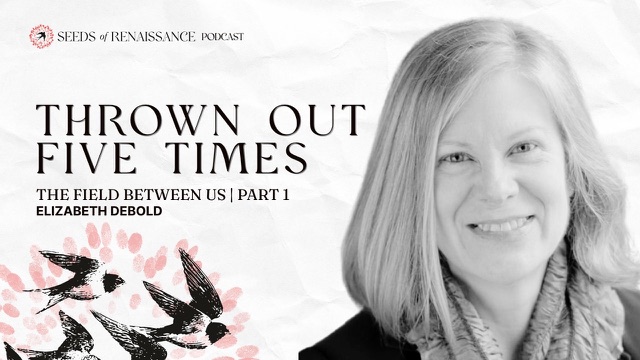
PodcastThe Field Between UsPart 1 of 4
Thrown Out Five Times: Why Elizabeth Debold Kept Going Back
A poem at sixteen, a tough teacher, and something real.
Series intro
This is part of a four-part series with Elizabeth Debold on interbeing and emergent dialogue.
Elizabeth Debold, Ed.D., came to the late Andrew Cohen's EnlightenNext community at forty with a Harvard doctorate and a bestselling book, and found something none of it had prepared her for: a field of shared awareness that opened between eleven women on a retreat in 1999, then between thirty men in 2001. She was thrown out five times and kept going back. When the community collapsed she and her partner Thomas Steininger, who died in 2025, spent the years since asking what that field was and how to cultivate it without a guru. Four conversations with Rufus Pollock: the story, the practice, the ideas, and where it could lead.
This episode
Elizabeth Debold’s forthcoming book opens with Hölderlin: where there is danger, a saving force also grows. Rufus Pollock asks about the danger first. Her answer: Western culture has lost any sense of the sacred, and you can see it in the licence to be cruel. From there: Descartes and animals as machinery, Charles Taylor’s buffered self, her forester brother looking at a 500-year-old redwood and seeing lumber, and Kegan’s self-authoring self as both achievement and trap.
And he said: This is like talking to one woman with eleven heads.
Then her story: at sixteen, a poetry assignment the night before it was due, and everything became one. Feminism, Harvard, a bestselling book, and the feeling that none of it went deep enough. At forty she meets Andrew Cohen, who says he wants to bring a group of women to enlightenment together. On a retreat in France in 1999 eleven women discover their fears are the same, something bursts, and Cohen says it is like talking to one woman with eleven heads. She also describes his methods as tough, the five expulsions, and the afternoon fifty students walked out when he said “I didn’t know.” Why stay? “There was something real here.” Part 2 is what that something was made of.
Chapters
- 00:00Hölderlin's question: what is the danger?
- 01:20Losing the sacred, and the licence to be cruel
- 05:36Descartes: the world as machinery
- 08:25Buffered selves, an oak, a brother with a chainsaw
- 16:44Haven't humans always done this?
- 20:24The self-authoring self and its trap
- 25:12Bacteria, the saving force, and a map with nothing on it
- 27:38Sixteen, a poem, everything became one
- 34:08Feminism, Harvard, and meeting Andrew Cohen
- 41:03France 1999: one woman with eleven heads
- 46:08Brutal methods and five expulsions
- 59:55"I didn't know": fifty people walk out
- 1:05:42Like being in water: the field of interbeing
Speakers
Elizabeth Debold, Ed.D., is a gender researcher, writer, and teacher who has spent four decades asking how women and men can grow toward freedom and equality together. She was a founding member of the Harvard Project on Women’s Psychology and Girls’ Development, co-wrote the bestseller Mother Daughter Revolution, and co-founded One World in Dialogue, a global network of people practicing deep dialogue.
Rufus Pollock is a co-founder of Life Itself, an entrepreneur, activist, and author, as well as a long-term zen practitioner.
Notes and links
Website: Evolve · One World in Dialogue
Upcoming event: The Rediscovery of the Sacred
Book: Mother Daughter Revolution: From Good Girls to Great Women (1993)
Transcript
Rufus Pollock (00:15) welcome, Elizabeth, to the Over the Mountains podcast. It’s great to have you here.
Elizabeth Debold (00:23) It’s wonderful to be here with you, Rufus. It’s great to go over the mountains.
Rufus Pollock (00:29) So really this is part of, I hope, a series with you where we explore both the kind of the situation we’re in, but especially the work that you and your partner Thomas Steininger and your other collaborators have been working on over several decades in the field of emergent dialogue and interbeing. And I wanna you I know you’re working on a book, and which is really a distillation of almost your entire practice over the last decades. And the book opens with Hölderlin. Where
Elizabeth Debold (01:04) Yeah.
Rufus Pollock (01:04) there is danger, a saving force also grows. And before we get to the saving force, what’s the danger? What exactly is not working, is broken?
Elizabeth Debold (01:20) Well, if you wanna jump in the deep end it is that Western culture has lost any sense of the sacred. that the recognition of the preciousness of life. just look at what’s happening right now. Look at what’s happening in the United States. In Germany with the AfD, just the rise of pernicious forms of fascism and a license to be cruel to people who are disadvantaged or or who are who are struggling. right now they’re thinking about they’re contemplating how to wipe out social security in the United States that will only matter to people who have very little funds but have probably worked hard during their lives, the majority of them, and at the end of their lives having this nest egg or this income that they’re like this is we want we want to give that give just destroy that. that there is there is nothing that you can expect from a from a government that th And also just the white nationalism or Christian nationalism, the trad wife movement, all these things that are that are really saying that some human beings are superior in essence than others. And those others deserve to be kicked down the stairs. And I think it it’s people often say, well yes, the world is cruel but that depends on us. And we’re it feels like we’re heading again towards something that occurred a century ago without very much reflection or looking yeah looking at ourselves or wondering what you know what are we up to, what is this, what kind of world do we want? But sacredness meaning having an embodied deep recognition of the preciousness of life, the extraordinary gift of life that we have. The way that the sacred expresses itself in beauty. in wisdom all of this is what Hölderlin is referring to as missing or as fading in Western culture. And he wrote that in the in the nineteenth century. So he this is this is he’s one of the German romantics and it’s part of part of a whole recognition that Western culture was headed in this direction with industrialism and or it’s even pre-industrial. but that something had been left out in our understanding of life and what’s important in life.
Rufus Pollock (05:08) So the key danger or the essence of that danger is the loss of the sense of the sacred or the loss
Elizabeth Debold (05:19) Yeah.
Rufus Pollock (05:20) of the sacred and that that’s manifesting in all kinds of ways right now in our world. And What kind of other ways do you see? you mentioned basically the way what you see in politics today, the way we’re treating each other. you talk in your book about the beauty of nature was being put under the microscope to dissect and extract what could be used. No longer did the creatures of earth shine with divine presence. The mystery of aliveness, they were seen as nothing more than mechanized matter. The sense of meaning was draining from the world and to Borrow another of Hölderlin’s fray language, the gods had taken flight.
Elizabeth Debold (06:09) Yes. The gods taking flight is the loss of the sacred.
Rufus Pollock (06:14) Hm.
Elizabeth Debold (06:15) And the reference to the mechanical that all other all creatures other than the human are mechanical wind up toys practically. That’s Descartes.
Rufus Pollock (06:34) Yes. Yes.
Elizabeth Debold (06:37) And actually that was something that I discovered recently. I don’t know how I missed it, but I’m a kind of a fan of Descartes in the sense that he if you really read him literally in describing what it is that he’s going through, he’s going through a very dangerous and frightening passage to declare himself autonomous and in ig in existence because of his own thinking. And it’s quite remarkable when you don’t think that he’s exaggerating, which we often do when we read someone from several centuries before. We that their perspective is somehow an exaggeration or a fantasy or something, when actually they’re narrating their experience and their perspective on what’s going on. But He perceived all beings, all animals as mechanical, and that their cries when they were they were hurt was just meaningless and that the
Rufus Pollock (07:59) Yes. Famously, the dog, the dog being cut open is simply I’m not like a
Elizabeth Debold (08:02) Yeah, just
Rufus Pollock (08:05) clock I like a watch that’s just giving out noises. So what
Elizabeth Debold (08:08) Right. Which is which is pretty horrifying.
Rufus Pollock (08:12) is horrifying and but I think at this deeper level it’s not only is it the sake of but it reflects that someone has somehow lost deeply contact with something.
Elizabeth Debold (08:23) Yes.
Rufus Pollock (08:24) And so you also because you also write about John Vervaeke’s meaning crisis about depression, addiction, nihilism, the loneliness epidemic. But you’re not just diagnosing the symptoms. And so you’re saying that the kind of root cause, in your view, or one of the root causes, is this loss of the sense of the sacred and a loss of the sense of, yeah, please.
Elizabeth Debold (08:44) What yeah, and let me put it put it then in another way, because what so what does a sense of the sacred give you?
Rufus Pollock (08:53) Mm.
Elizabeth Debold (08:54) what is that about? And that’s about connection. That’s about belonging to life and belonging to life itself, if I could use that term, is about a profound non separation with the creative force of aliveness. And that that the sacred is what we what we experience or because I’m not talking about a sacred that is didactic or, Jesus Christ was the Son of God, therefore he’s sacred. I
Rufus Pollock (09:43) Yes.
Elizabeth Debold (09:45) he may he may well be, but that’s a different conversation. I’m talking about something that touches one so deeply. that one is stopped in one’s tracks, a recognition of belonging so be so beautiful and so connected that one is humbled and opened. that something that happens between you and another or even you and your puppy you and your children but you in an oak tree where you lean against the oak and you feel the energy rising in the trunk and you realize that it is in a sense your ancestor. That the oxygen that it now produces is what enables you to live in this atmosphere. It’s like these deeply connected, profound experiences that intrinsically have meaning. This is what the world of the sacred is about. It’s not it’s not about something performative, it’s not about Something that someone tells you is sacred.
Rufus Pollock (11:07) Yes.
Elizabeth Debold (11:10) It is something that arises in your experience of being human. And it’s that quality of that experience and the connectedness and the sense of sense of wholeness and I said belonging before, wholeness and
Rufus Pollock (11:29) Yeah.
Elizabeth Debold (11:30) preciousness that
Rufus Pollock (11:32) You sorry, yeah.
Elizabeth Debold (11:34) that opens there is one of the ways We experience meaning in being alive.
Rufus Pollock (11:45) Yes. And you’re what I’m hearing you’re saying is that at a deep level, this loss of connection to the sacred, to life itself, to aliveness is underneath the eco some of the ecological crisis, the level the meaning crisis and loneliness epidemic, this disconnection, even though the growing level of lack of committed relationships and children, the fact there’s this huge declining levels of birth rates in the West. You would see that me underneath there’s this kind of underlying disconnection that has gone on. Is that
Elizabeth Debold (12:27) Yes. Yes. That we have become, as Charles Taylor says, buffered selves. we have be
Rufus Pollock (12:37) Mm. What does that tell me about that?
Elizabeth Debold (12:41) Every time I read the term or hear the term, I think of I think of a kind of mummy. And actually this may this may relate to Vervaeke and I don’t remember his co-author on this book, but where when they write about zombies,
Rufus Pollock (13:01) Mm.
Elizabeth Debold (13:02) the sense of being wrapped in bandages, completely buffered from any direct contact with life or the air or the sun, really. That one has a transactional or instrumental relationship to all of nature. You I remember my brother who was a forester, at one point, and I think this was try he was trying to get me. He we were in the redwood forest in California and he said, You know what this reminds me of? And he says, Me with a chainsaw. It’s like I look at this beautiful, pristine forest that with trees that are five hundred years old, and I think with a chainsaw I could I could knock this down and turn it into lumber and get and get a good price for it. That’s what I mean.
Rufus Pollock (14:09) Yes, and it’s like it reminds me just for myself or that When I was in a museum, I think it was about a year ago, and looking at indigenous communities that had been in the American Northwest, like British Columbia,
Elizabeth Debold (14:27) Uh-huh.
Rufus Pollock (14:28) and they would still use trees. They made boats, they would use the bark for various reasons. But there was a kind of th for example, they very carefully would take bark so the tree kept living. There would be a whole process by which they would almost go and ask the forest, which tree they could use. Now even if w
Elizabeth Debold (14:46) They would ask.
Rufus Pollock (14:47) yeah, and even if you’re a somewhat reductionist and you don’t think you’re really asking, the very ritual of it, even if you think it’s a performative thing, the very aspect that there is some process where it’s not like we just take whatever we want and there’s some consideration, there’s some relationality and at the deepest level an appreciation of the living, of course there’s exchange. I’m saying because sometimes people can hear this be does that mean that we never use any wood anymore? And no, that’s not what one is saying, but there’s a way of it. There’s a way when you just look at something and calculate it as so many square feet of lumber that can be used or profited from. And a very different one when you’re in that kind of relationship of going to the forest and asking and then using in some considered way. of things. There’s a connection to the sacred in that kind of practice that there seems to be missing when you’re just the chainsaw.
Elizabeth Debold (15:38) Right, right. That it’s that it’s the attitude of being cut off. to
Rufus Pollock (15:46) Yes.
Elizabeth Debold (15:47) that one is cut off from the implications of what one is doing with the effect on the larger bioregion or even immediate region of the forest. the relationship between it goes it goes all the way down and all the way up. the destruction of the mycelium that keeps the forest alive and in communication from the in at the lower level to global wood lumber markets and are you taking too much from here and it’s and it’s it what effect is it gonna have in terms of even the availability of lumber in the future if you’re cutting down all the trees where you are?
Rufus Pollock (16:34) Yes.
Elizabeth Debold (16:34) it it’s relationship and relatedness and connection all the way down and all the way up.
Rufus Pollock (16:44) I guess I’ve got one question if I were probing at this point is we also know that civilizations in the Euphrates Delta five thousand years ago, even before the Axial Age, cut down all their trees and
Elizabeth Debold (17:02) Yeah.
Rufus Pollock (17:03) de Sa Salini had problems with irrigation and salinization and they made their land possibly infertile. Is this what what’s happened recently? there’s Hölderlin’s writing in 1800, roughly Is this something that we’ve always been cut off in this way, or is it changed? Or if I was skeptic, I’d say, but look, humans, gatherer hunters, over hunted, woolly mammoths. What’s different now? And what and not just a rational sense, but can you sense something? There is something about the mechanistic dominance, just even a chainsaw, there’s something about it. It’s like, wow, the just the it’s not a very sacred object. But what Yeah, if a skeptic were coming along and saying a little bit like, Well, but okay, haven’t we always done things like this? Isn’t it just a scale thing?
Elizabeth Debold (17:59) May let’s say I wonder if there is there and I think this is prevalent that there is a wise a belief in the in the ultimate total wisdom of the indigenous people or of tribal living. And there may have been responsibility in a certain context. But to be able to zoom out and see the effect of what you’re doing on a larger a larger swath of land or whatever, they’re not omniscient.
Rufus Pollock (18:41) Yes.
Elizabeth Debold (18:42) They made mistakes. and of course different empires that existed that are that are pre traditional where with slavery and ritual sacrifice and all those good things. It it’s humanity has been a work in progress for a long time and every stage
Rufus Pollock (19:06) Yes.
Elizabeth Debold (19:09) there may have been some I’m try can’t remember the name of the empire. I think it’s in Central America.
Rufus Pollock (19:20) Aztecs?
Elizabeth Debold (19:22) could be. Yeah, but
Rufus Pollock (19:23) He had human sacrifice and so on.
Elizabeth Debold (19:25) that human sacrifice the that but that was in a context of actually something considered sacred.
Rufus Pollock (19:38) Right.
Elizabeth Debold (19:39) but I’m not saying so let’s go back and do that.
Rufus Pollock (19:43) Yes. It’s the combination. It’s that something’s happened. There’s a scale of identity and there’s this disconnection, this buffering of the self, this cutting off. And
Elizabeth Debold (19:54) Well, it’s also about technology and the
Rufus Pollock (19:56) Right, Tom.
Elizabeth Debold (19:58) the development of technology and the development of technology at a more rapid pace than the ethical responsibility to use technology. Well, you see that right now. We’re right in the middle of it. We’re in the middle of a situation with AI where we don’t know what is gonna happen and we don’t wanna slow down. It’s a race. We have to win. but it’s I think a lot of it has to do with the rise of individualism and the aspiration of or the transformation of human beings in context in context that of nature, of family, of community, being ripped out of that or aspiring to become how to say it. at I just watch a podcast with John Vervaeke and a few others, being sole authors of your life. That’s actually a developmental stage in
Rufus Pollock (21:07) Yes.
Elizabeth Debold (21:08) in Kegan’s in Kegan’s developmental trajectory being self-authoring. This is like a an epitome of human development and it’s amazing. But it’s also I am I am the only one who authors my life. There is no connection with something bigger than oneself. And what does that mean? And so you’re on your own. You’re on your own as a human being in Western culture. You stand on your own two feet, that’s that how that’s great. But you stand on your own two feet separate from everyone else, and that’s the only spot you’ve got is under your own feet. And that place is insecure, so you’ve got to fight for it. You’ve got to acquire all kinds of stuff in order to to buffer yourself, go back to that, from the from uncertainty. Because there’s nothing that you’re anchored in other than you. And deep down that you can’t handle that. You can’t control that. And that makes us a little unstable, let’s put it that way.
Rufus Pollock (22:30) this is something I then want to bring out. you’re a you’ve been a developmental psychologist. You got your PhD under who was I rem Carol Gilligan and you were there
Elizabeth Debold (22:42) Carol Gilligan? Yeah.
Rufus Pollock (22:45) at Harvard with Kegan was there and so on and then you’ve done a from integral through to quite a lot of other things. One thing I want to bring out of that, why I bring that up is that you said something very important is that you’re not There is something really there is a real danger, as Hölderlin is saying. And we did need to maybe go through this stage of individuation and becoming individual. The issue is it’s become like the pendulum has swung too far. And it’s not necessarily that we want to go back. We want to we want to swing back, but going around the spiral. could you say a
Elizabeth Debold (23:21) Right.
Rufus Pollock (23:22) little bit about that background of your work? Because I think sometimes people can hear it was a disaster we want to go back to before. Whereas what you’re saying is there was something very precious about becoming self authoring. But there is also a trap that we become, I’m now just all about myself. it’s all the it’s
Elizabeth Debold (23:39) Right.
Rufus Pollock (23:39) self authoring. And there’s no path transcending that.
Elizabeth Debold (23:42) Right. And yeah, that that’s not that that’s not part of the equation is transcending that. Well, Kegan does have stages beyond the self authoring.
Rufus Pollock (23:53) Yes, he des, he does.
Elizabeth Debold (23:56) but fundamentally it’s still about being one’s own person or being
Rufus Pollock (24:05) Yes.
Elizabeth Debold (24:06) a source of creativity and even the next I can’t remember the name of the next stage, but it’s about again learning from others your own your the holes in oneself or the limitations in oneself. So it’s even in a certain way a way of instrumentalizing intimate relationship for one’s own development. And That I’m exaggerating a bit here, but I think the emphasis on in on the individual is so deeply embedded in Wilber and Kegan and in all of our models of human development, which is why I think and I’ve said this I I’ve said this to you before I think, why I find this opening that into inter being. to be such an amazing thing because it’s not on our maps because it takes us into a subtle dimension that is beyond this solo flight individual and yet without losing our capacity for choice and for uniqueness and creativity and that’s a that It’s like nobody saw it. This emerged in a context in between people and it’s developed and grown. But it’s not it’s not something that anybody’s developmental map pointed to.
Rufus Pollock (26:01) And so we’re gonna and so what you’re starting to describe here is what started that you and Thomas and others started to discover and which you’ve also this field of interbeing, as you might tell it tell us more, and also the practice that you started to have with it, is that right? That the
Elizabeth Debold (26:23) Yeah.
Rufus Pollock (26:23) the of emergent dialogue. But just what That’s what you’re alluding to. And what I want to say is you’re saying, because in your book, this wonderful hour you say, it had to get to this point. Life changes itself only when it needs to,
Elizabeth Debold (26:36) Yes.
Rufus Pollock (26:37) according to the late evolutionary biologist Elisabet Sahtouris. And you said, maybe this is this moment now. Life leaps beyond danger to make the continuation of life possible. Sahtouris points to the critical moment in the evolution of life on Earth when oxygen was filling the atmosphere and poisoning the bacteria that are our oldest ancestors. A leap happened. Bacteria combined as they never had before and formed the cells that then made multicellular organisms, including us. Countless leaps later, here we are. Danger is present and the saving force grows. And you say this book is about the saving force that is emerging now. no longer about bacteria. it’s about human beings coming together to create new ways of being, knowing and loving out of the wholeness that we are all part of.
Elizabeth Debold (27:25) So you were just reading from the draft of my book.
Rufus Pollock (27:28) But yes, that’s what I’m saying. That’s what I’m saying. I’m reading what you wrote. That’s what I’m saying.
Elizabeth Debold (27:32) Yeah.
Rufus Pollock (27:32) What you I was reading a quote for you from it. It sounds pretty good.
Elizabeth Debold (27:35) Sounds pretty good.
Rufus Pollock (27:38) And can you tell me how it emerged in your life? Tell me a little bit of the backstory of how you started to touch this saving force. that
Elizabeth Debold (27:46) Okay.
Rufus Pollock (27:46) was not on Wilber’s map, that was not on Kegan’s map. Yeah, tell me the biographical a little bit, maybe even a little bit where what you were what was you doing before you then started in this and what led you to it?
Elizabeth Debold (27:57) Okay, let’s start here. Since I was in high school, well let’s put it this way. There are two streams in my life that came together in this. one is that when I was in high school I had a profound spiritual experience that came out of the blue, which happens a lot with adolescents. teenagers, teenagers, people in their early twenties. there’s a there’s a cognitive shift that’s happening at that time. It’s a it’s a it’s something that is well documented. It’s a it’s a it’s a yeah, powerful developmental shift. And in that shift, it’s almost as if your org your brain was organized in one way and it then needs to organize in another way and as it’s moving there are cracks in it. And in those cracks something can come through. And this often happens often happens with young people. it’s cultivated in some religious groups that they will they will do summer camps with young with the members of their young members of their community and get them to inquire and then the inquiry like, Well what is life or what does it mean to be human? Things crack open.
Rufus Pollock (29:26) So that happened to you when you
Elizabeth Debold (29:28) Yeah, that happened to me.
Rufus Pollock (29:31) And what happened
Elizabeth Debold (29:31) Yeah, that
Rufus Pollock (29:31) then?
Elizabeth Debold (29:33) I had no idea what it was. I had no idea. I was not living in a context I was raised Catholic, but I was not living in a context where spiritual experience was something that people talked about. But I knew that it was the most important thing that ever happened to me. I was sixteen, seventeen. I knew that this is it. Whatever we’re doing here on earth. This is it. This is this is why we’re here. Whatever that means. And it happened because I had an assignment due in my English literature class. The teacher asked us to write it write poetry because we were doing a unit on poetry and she said it’s not fair not to try not to not to give it a try to realize how hard it is to write something that has impact and meaning. so by Thursday or Friday or whatever it was, I want you to write at least three poems. And so it was the night before as usual, and I crept downstairs out of my mother’s earshot. she was in bed and And sat on the floor in the dining room looking up at the at the pine tree outside and the moon in the sky. And I was like, I have no idea what I’m doing. I have no idea how you write poetry. I have no idea. And in that space of like, pfft, I have no idea, which anyone with a any spiritual background knows that that’s the place where things start to happen. Something cracked open and everything became one. It I felt like all the categories and things in my mind had been lifted off and I saw something that was total. Or I experienced something that was total. And so I thought this is what inspiration is. This is what poetry is about. That it’s a form of inspiration. So I read Rilke, Dylan Thomas. I read everybody on the on about writing poetry. Emily Dickinson. And I became the class poet. And it actually was an experience that changed the trajectory of my life. because my teacher asked me a few days later if I would be willing to read my poems aloud to the rest of the class, and I said I couldn’t and I meant by that I meant I really couldn’t because I didn’t have the capacity because I was I was so quiet a person that I didn’t I didn’t speak until this class, which was my favorite. I didn’t say anything to anyone. So
Rufus Pollock (32:49) Mm.
Elizabeth Debold (32:49) by eleven o’clock my voice was often when I would start to speak in that class, I’d be like trying to get my vocal cords like moving. But I said, I can’t I can’t do that. And so she said, Do you mind if I do? And so she read them and then we when I was leaving she said, I want to talk to you. I want you to be I’m she said, I’m the faculty member in charge of the literary magazine. You need to be on the board, you She just boom changed my life right there. It’s touching. Which is what a great teacher can always do. But so yeah, that began one stream of adventure in my life, which is what is that? How does it work? What’s it what does it mean? What does it mean to other people? How do we how do we yeah, how do we make this the foundation of who
Rufus Pollock (34:00) Mm.
Elizabeth Debold (34:00) we are and how we are together? And then the other piece was my was about Men and women, this was the early seventies and it was at the kind of peak of the feminist, the early feminist or this the third wave really of or second wave, second wave feminism. I get I get them confused some there have been four or five now by now. and Just always having the question because of my parents being so hostile to each other. how do how do what do we do about men and women? What do we do about this kind of mutual disregard or disrespect. That women I saw my mother felt herself superior to my father because he was emotionally clueless and lacking in certain kinds of practicalities, which is unusual for a man actually in a certain way. And he had contempt for my mother because She, didn’t work. He called her stupid, and so and so and so forth. So it’s like, ugh, what do we do about that? And so I pursued both for quite for some time. And then the spiritual dropped out. I forgot about it. And then I was active in the National Organization for Women. went through activism consciousness raising and then said no this isn’t enough and then I went to graduate school in developmental psychology and went no this isn’t enough this isn’t going deep enough and then through a fluke af I met I met was pulled into It wasn’t that I met him, but a lot of people conspired for me to meet a young spiritual teacher named Andrew Cohen. And I became
Rufus Pollock (36:34) Hm.
Elizabeth Debold (36:35) I said I talked to a friend of mine from the feminist movement and said, I just feel that maybe it’s one in a million chance, maybe it’s completely crazy. But this man is saying that he wants to bring a group of women to what he’s calling enlightenment together. And that in and he recognized as I did that creating a true sisterhood or fellowship between women would give women the grounding to be able to be free from men in all the toxic ways and that could that could rebalance men and women’s yeah, men and women’s relationships and also then than themselves. And I thought it’s like I’ve gone through most of the things that the culture offers. I’d written a book by then with two colleagues, Mother Daughter Revolution. It’s like I’ve gone there and
Rufus Pollock (37:48) Yes.
Elizabeth Debold (37:49) this there isn’t anything deep enough. But maybe this would be. So that’s how I got into this spiritual community that eventually this teacher Cohen, Andrew Cohen, set up a context, how to how to put it.
Rufus Pollock (38:15) So you meet
Elizabeth Debold (38:17) Yeah, this is this is now the early nineties. Yeah.
Rufus Pollock (38:20) Cohen and there’s this community that then develops. And what happens?
Elizabeth Debold (38:26) Yeah.
Rufus Pollock (38:26) Because you actually do have quite a powerful, a very powerful experience. can you say a bit then about what happened
Elizabeth Debold (38:32) Yeah.
Rufus Pollock (38:32) and what manifested amongst you?
Elizabeth Debold (38:35) Yeah, well there’s a certain point where he where he says, Okay folks, I I’ve been talking about this collective or this well, I let me put let me start a little bit back further. ‘Cause
Rufus Pollock (38:48) Yes.
Elizabeth Debold (38:49) he had been teaching for ten years when I met him. And in those first ten years he noticed at some point early on that there was a field around him. that when people entered and were engaged with it, that something seem some separation and a kind of open curiosity, love and yet desire to a shared inquiry would blossom between people. And there was a spark that would that would jump from one to the other and it was There was something very powerful and he said, This is more important than me, than what is happening with me. This that’s happening between people. And he said, I this is what I’m here to realize, or I’m here to make happen. and so at finally I think it about th yeah, somewhere around the nineties, somewhere around the time that I sh that I showed up. in his community, he started to put pressure on people to come together and pressure on their ego structures, their self structures, to trans to self-transcend and create a space, yeah, a space of non-separation between them. And it was he was brutal and And I yeah, he was he was brutal and by that he stuck your face in your in your flaws, your weaknesses, in a way that hurt a lot of people. A lot of people were deeply wounded and shaken by the experience of being with him. And But at some point, at one point on a French retreat in France, I think it was I had just been invited to be a student at a certain level, I think, and we women Andrew kept checking in with this group we were all peers. And he kept checking in with us and saying and he said to me, You’re just not interested in coming together with other women, are you? You just aren’t interested. And I was so confused by that. And we but we just we started to dive into our experience and discovered that it was it was the same, that our fears were the same, that our that the experience of sh of cutting off from each other was the same, our judgments were the same. And in that, in the excitement of discovering the fact that we had been that we were we were not separate in the way that we’d been conditioned, something burst. And in that and And there became a force field between us that was really extraordinary. Andrew called us almost immediately and said and said, I heard you laughing. what’s that about? And we just all started talking one after the other. And he said he said, This is like talking to one woman with eleven heads. And there I remember distinctly. looking out at the crowd of people that were on the retreat and there was a different shimmer to the women who were connected, that we were alive to each other in a different way. And Andrew was like, now I know it’s possible because this is the first time it’s happened. The second time it happened it involved my partner Thomas Steininger was instrumental in in holding and leading something that ended up being an even larger eruption between this a group of men who had been on retreat for quite some time. And they broke through I remember speaking to some of them. some of them or after they had several nights of meeting and having this kind of opening to a different perception of life and of living and of being alive and co-creating co-creating as they were speaking a perceptible reality of non separation and yeah and it light I would say and Yeah, what there was something there that I wanted to add, but I can’t remember.
Rufus Pollock (44:32) And this was a group of this was then a group of men. This was about two thousand and one I think. In Foxhollow
Elizabeth Debold (44:36) Yeah, that was two thousand one.
Rufus Pollock (44:38) and it was a group of quite a few fifty, forty, fifty people, twenty twelve
Elizabeth Debold (44:43) It was about ther I would say it was about thirty men.
Rufus Pollock (44:46) about thirty men. And it lasted for what several days or a week.
Elizabeth Debold (44:50) Yeah, may maybe and it kept it flickered on and off. And then
Rufus Pollock (44:54) Yes.
Elizabeth Debold (44:55) yeah, what would happen is it would it would it would light up and then phew well actually it wasn’t exactly it this is interesting because it would it would light up and then you would be beyond yourself. Meaning in many ways that you were in a space where you didn’t you didn’t have a memor your memory couldn’t track you there. And but you would think afterwards that what happened was something like, wee, an emotional high, isn’t this exciting? Woo, this is so much fun. And that, which was not what it was at all. It was a reinterpretation in using the apparatus of the separate self. And
Rufus Pollock (45:46) Yes.
Elizabeth Debold (45:47) and that happened over and over again and until there was one point where people started to come together and this would spontaneously arise. So outside of it so it started to develop and that became that became very exciting.
Rufus Pollock (46:08) And this is so this is that you’re touching some kind of new or breaking through to some kind of collective field, a trans individual field. It’s transcending this. And this is what got you so excited in Cohen’s work in that community, was even if there were
Elizabeth Debold (46:28) Yeah.
Rufus Pollock (46:28) these challenges or difficulties. I think you once told me even that you had to leave five you were made to leave by Andrew five times and came back,
Elizabeth Debold (46:34) Yeah, that was kicked out.
Rufus Pollock (46:35) kicked out five times. There was a there was something that was going on very, very powerful there that you were very
Elizabeth Debold (46:44) Yeah. Yeah.
Rufus Pollock (46:46) cool to. And so then tell me, obviously and in your again, I this book, the upcoming book, which I think I’ve got to read early a little bit of early drafts will be incredible. you describe there was also then this breakdown of that community, in a variety in some ways, but the enlightened what the community
Elizabeth Debold (47:03) No, it was a total breakdown.
Rufus Pollock (47:05) Yeah, what do you want to say? What happened?
Elizabeth Debold (47:08) Well I think th a few things happened. One was Andrew’s methods Andrew’s methods were crude and brutal. He was not he was not a I don’t feel that he was a good teacher. So for example, if you’re in a circle of people and something starts to arise, something starts to starts to happen, there’s something that a coherence that is forming, that there’s a there’s a shared a shared yeah, consciousness that starts to emerge. The group starts to to tend to itself. It a kind of co-consciousness begins to arise it through your the experience and the contribution of the people in the group. But you are feeling a little anxious and you’re not sure that you’ve got it. you’re wondering if you’re feeling a little out of it And you can’t find a way to contribute that the kind of it’s like it’s starting to move and you can’t catch up and jump on the on the merry-go-round. you miss it, you fall in the dust. So very likely after a meeting like that, let’s say I did that, someone would approach me, somebody higher up in the hierarchy would approach me and would say, Andrew wants to speak to you or pack your things and get out of here and you’re not allowed to come back until Andrew says so. pretty harsh.
Rufus Pollock (49:10) Mm.
Elizabeth Debold (49:14) and he could have said, it’s really delicate. This consciousness is very fragile. And to me, particularly because I was I was within the community, a somebody who came in with a New York Times best selling book. there was a lot of weight associated with me because of the and the leading role I was playing with the women. So if I messed up and it created a bigger weight in the group. Now Andrew could have said that to me. He could have said, you need to think about this or this or that you’re you seem to be hanging on to or but you can’t be in the group right now. because you bring too much authority and you’re missing the boat. But he wouldn’t say that, he would just act in ways that were cruel and made life incredibly painful and difficult for people.
Rufus Pollock (50:26) Mm-hmm.
Elizabeth Debold (50:27) And on top of that he would he would also contrive certain punishments for people and then would laugh about it. Laugh at their pain. And I think this quality of sadism in him was something that he’s never acknowledged, but I think was one of the most damning things about his leadership.
Rufus Pollock (51:00) Mm.
Elizabeth Debold (51:07) But to me, I felt we were this was there was something real here. There was something real here. And I had a fortunately enough life experience in the world as it is to un to understand that. And I think a lot of people didn’t and found themselves very hurt by this. I also had enough background as a developmental psychologist to understand that what was being reached for was something that was really really different.
Rufus Pollock (51:42) Yeah. Yes.
Elizabeth Debold (51:45) And so my original question about what do we do with this men and women business, that was that was im the capacity to change us at this level, to open this space between us. what happened with between men and women became it opened up something completely different. There’s a lot about Andrew and his relationship with women that was that was really to say unwholesome would be and I don’t mean there was any sexual thing, but his derision deris I deriding
Rufus Pollock (52:32) The riser area, yeah.
Elizabeth Debold (52:34) women and so forth was I came up with a whole training program about women’s history and the development of the good woman character and not character but the it’s
Rufus Pollock (52:50) Mm the archetype.
Elizabeth Debold (52:51) yeah the archetype of being of goodness and so forth and why that is not inherent to women. That is something that is culturally mandated. And all this stuff as a way of countering his disregard and disrespect of women. However, even in that it there was something that was happening between men and women, and the between women that was that was groundbreaking. I remember a very a A dear friend who is a spiritual teacher in her own right, coming to do I think a workshop with me and a few colleagues. And she at one point we were having dinner and she said, I don’t feel it. I don’t feel this kind of buzz of competition that is that is always present in my experience between women. And we said that this is what we’ve been working on. This is what we’ve been here to do. So all of that was I felt that despite the cost to myself or because I can yeah, it was the pain of the dislocation and so forth that at being thrown out five times. ‘Cause you’re not given any it’s not like you’re given in prison when you’re let go and you’re given some money to be able to start over or at least have a hotel room for a couple of nights. It’s like, nah, you’re on your own. Completely on your own. Walking down the street, carrying a backpack.
Rufus Pollock (54:49) think this is amazing you’re sharing because I think my sense and I’m th is that the EnlightenNext community and Andrew Cohen’s the community that grew up and I think it’s not Andrew Cohen there because there were people like you there were many other people who became who generated that field and particularly the diaspora after the blow up which then happened around twenty ten, twenty twelve. I don’t think people but I do think it was there was something very extraordinary happening there. When I meet people out of that diaspora, when I meet you, when I meet Thomas, when I meet others. Well, there were the all of these challenges, and you could say something that led to then the breakdown, which was even in a way some kind of growth in that some of you in the leadership stood up to Andrew
Elizabeth Debold (55:34) Yeah. Yeah.
Rufus Pollock (55:36) and there wasn’t any of the classic stories, which was there wasn’t sexual abuse or any, just say, but there were the there were these sh deep challenges you’re sharing very powerfully about. But there was also something extraordinary. Now, we want a world where we have that extraordinary thing, and that’s what you and Thomas we should come to are working on without the guru figure.
Elizabeth Debold (55:54) Right.
Rufus Pollock (55:54) and the dysfunctions that can happen from that. But just want to say because I think EnlightenNext is underknown and can you can end up on the Wikipedia page and is it another of these kind of things where there was some, X or Y. But there’s something quite extraordinary happening there, is what I’m hearing.
Elizabeth Debold (56:12) Yeah.
Rufus Pollock (56:12) And you’re also acknowledging and just say, so what happened in the end, because the community in a way the formal community around Andrew dissolved. what yeah, what
Elizabeth Debold (56:22) Yeah.
Rufus Pollock (56:23) happened there?
Elizabeth Debold (56:24) Well,
Rufus Pollock (56:24) towards it.
Elizabeth Debold (56:25) as you were saying that some of the there was there was frankly a move for independence. quite a few of us had begun had begun teaching and we which was which was fine. I think at a certain point when things were going were going quite things had stabilized somewhat. People were different ones of us were teaching. Andrew became quite paranoid about not being needed any longer. And he kept saying, You still need me. I talked to Ken Wilber and Ken said that there’s always the need for the guru. And so on and it was like we were like but no one’s saying that. And I think more and more of us became independent of his judgment. and I think Or and we’re sharing that with each other. That was the that was the thing. but basically what in a nutshell what happened was that he it became very clear that he was not living his own teaching and he had put so much pressure on us to live his five tenets. And one of them, the second tenet is the law of volitionality, that says that basically whatever you have you whatever you have caused you intended. Right? Which is which is a phenomenal statement and one that many people would just slap down and say, forget it. But in my experience, it was it was quite extraordinary because if you really put yourself under that kind of intensity of scrutiny about something that you did that hurt someone, offended someone, made a made a blunder, just ruined some project or whatever. If you really focused on your own behavior, there’s often a moment, a window that opens where you realize,
Rufus Pollock (58:59) Mm-hmm.
Elizabeth Debold (59:01) I did this rather than that. I made I made this choice and I knew it was a bad choice. But I knew it would affect him some way or I it was petty. And actually that’s the tragic thing. Most of the reasons why we do things that are that are offensive or that hurt other people are petty. They’re not they’re not some grand philosophical reason or some deep horrible flaw in yourself. Neither. They’re it’s like, I just wanted to look good. or I wanted people to like me. so but
Rufus Pollock (59:52) You’re saying the second tenet, you were looking at him and
Elizabeth Debold (59:53) Yeah, but yeah, but so when it became clear that he wasn’t living his teachings, he had a call with one group of his students who were the kind of the very committed, living together, living in community, etcetera. And he said, I didn’t know I didn’t know that I was not living the teachings. I didn’t know that I was doing this. And they all went, your second tenet says that it’s volitional, that it’s something that you that you have done. And he was like, No, I really didn’t. I really didn’t know. Which of course is all of us who had been put under the microscope before by him. were not allowed to answer that way, if you know what I mean. It was like yeah,
Rufus Pollock (01:00:52) Yes, yeah.
Elizabeth Debold (01:00:53) you find that place in yourself. You find out what you’ve done.
Rufus Pollock (01:00:59) Yes.
Elizabeth Debold (01:01:00) And but at that moment when he said he said, I yeah, I didn’t I didn’t know the that entire part of the student body reared up and went like you’ve lost my trust. You’ve y It’s one thing to be part of a an organization where the teacher is being really rough on other people as already a difficult thing. But when the teacher is like unwilling to pay the price himself, it’s like no No, that’s too much. The this and then the and then really the whole thing just fell apart. Because you had fifty people at a at in one afternoon basically deciding to walk out.
Rufus Pollock (01:01:55) Yeah. And what’s incredible though, and you and we in a way I’d like today, almost coming to our moment, that we should leave the trailer for the next episode, but th
Elizabeth Debold (01:02:06) Mm-hmm.
Rufus Pollock (01:02:06) that experience of this opening, I think it was the word you kept using, first in this group of women in France, then in Foxhollow amongst men, and then ongoingly, this was it. This was something you were like, wow, this is what I’d been
Elizabeth Debold (01:02:25) Yeah. Now we’re working Yeah.
Rufus Pollock (01:02:26) this is what I’ve been looking for. This is and this is what led you because there is this incredible also diaspora, including I think very prominent you and Thomas who passed away last year, but the emergent dialogue and the work you’ve been doing is okay, how do we cultivate that kind of field? And what is this that is coming and what is it that hasn’t really been on the maps, the developmental maps of anyone and it’s something, this collective field that we’re talking about, it’s not an individual, it’s something And it’s this, in a way, I don’t want to say a solution, but it’s this thing of the hyperdivision, what is next? It’s not going back to the tribe, it’s not going like we’re gonna go back to, the old world of
Elizabeth Debold (01:03:09) Mm-hmm.
Rufus Pollock (01:03:09) submersion into collective is something new where the individual is still there somehow but taken up. And just could you say a very few words almost as a trailer, because we’re gonna then really talk about that, I think, in the next episode, what that is, what is this field of interbeing as you now call it, what how do you cultivate it? What have you learned about it in the decades you’ve now been practicing and cultivating it? But just as a one that’s a trail but I’m saying there’s a trailer for the next
Elizabeth Debold (01:03:30) And that’s a that’s a trailer. That’s a trailer, Rufus?
Rufus Pollock (01:03:34) episode. Maybe just a what a few words as we end today on like what Have you then been doing for the last well, two decades or more of I it’s thirty years ago almost now that you first came around first started working with Cohen. It’s well, fifteen years since you the community and you move you moved out.
Elizabeth Debold (01:03:51) Yeah, fell apart.
Rufus Pollock (01:03:52) What is it? Yeah, what is this field you’re trying to cultivate and what have you been working on there? In a very in a minute.
Elizabeth Debold (01:03:58) In a minute. Well first I want to say that after this collapse, the only group that really continued was the center in Germany, which was being led by Thomas Steininger. And it was he protected his people from Andrew quite a bit. And And I came I came to join I joined him here in I’m in Frankfurt right now. In Frankfurt where the EnlightenNext Center for Germany was and he asked if there was he asked the group if they wanted to continue or not and they said they said yes and most of them left after that. But the a small group has continu continued And speaking to them recently about this, they spoke about having a deep sense but a mysterious one, that there was something just again what the way we’ve been speaking about it, that there was something real. There was a new a new reality that they had glimpsed. And the question was, how do we how do we live that? How can we live that? And for us, for Thomas and myself, it was can we can we take what is what happened at EnlightenNext and can we carry it for learn from it? Can we learn from it how to how to bring people in to this field? And the field the field is a is it one is capable of sensing it and literally meaning a space between, beyond and through us, like being in water. when you’re in water it’s behind you, it’s around you. It has it has qualities. And the qualities of this field are part of the one of the qualities is it has it a distinct intelligence that one experiences as beyond oneself. the experience of the group as a whole is like, whoa, there’s something else that is present here that is synergizing our differences, that is seeking an seeking to create synergy between us that allows for a different way of integrating difference. So creativity and difference and diversity become very important to bring, to be to allow yourself to be yourself. But in the context of we’re not but, but in the in the context of this cool pool of intelligence that one is that the that the group as a whole is sharing. So it’s
Rufus Pollock (01:07:27) Yeah.
Elizabeth Debold (01:07:27) a form of collective intelligence. that doesn’t diminish that doesn’t dim
Rufus Pollock (01:07:32) Collective wisdom or collective
Elizabeth Debold (01:07:34) doesn’t diminish the uniqueness of the individual. And it depends on the individual’s choice to participate.
Rufus Pollock (01:07:43) Yes.
Elizabeth Debold (01:07:44) It’s not something that just happens.
Rufus Pollock (01:07:47) Yes. Wow. Well so I wanna say to listeners, if you’re listening, come in. We’re gonna do several episodes with Elizabeth. but thank you so much. And if you wanna le listen more and see what happened in this extraordinary possibly emergence. So I what I think just to try and give an analogy, because it can be difficult for our I think my one’s normal rational brain sometimes to is to think of what happened with bacteria. You mentioned this in your book, that when bacteria formed and made multicellular organisms, they didn’t they didn’t lose themselves. They maybe they became the mitochondria in the cell, but there was something bigger. There was something that emerged that took up those things. Now it’s a very crude analogy but what you’re saying that’s this maybe
Elizabeth Debold (01:08:34) Yeah.
Rufus Pollock (01:08:35) that maybe this field has always been there, but this collective field of interbeing, of this which has an aliveness, which has an intelligence. and it’s not about that we lose ourselves in the sense that we are gone, but rather we are taken up into something is what I’m hearing and
Elizabeth Debold (01:08:52) Yeah.
Rufus Pollock (01:08:52) sensing. And so on that note, I think we should end, Elizabeth,
Elizabeth Debold (01:08:56) Okay.
Rufus Pollock (01:08:57) and look forward to the next saying. Anything you want to say and also I always want to say at the end, Elizabeth and the team Evolve World and their practice of emergent dialogue, you can go to their website. I will put it will be in the show notes. They they’re doing an interbeing monastery.
Elizabeth Debold (01:09:14) Yeah.
Rufus Pollock (01:09:14) There are many events that they put on that you can attend. I don’t know if you want to say anything very quickly to that, Elizabeth, but I put them the show notes.
Elizabeth Debold (01:09:20) Yeah. Just check out the Interbeing Monastery where we have an open interbeing lab where we ex where we explore and yeah, have a laboratory of interbeing and also a new practice called interbeing tea dialogues, which brings out the collective nature of our most personal problems. And Problems and excitements.
Rufus Pollock (01:09:52) Okay, well, and tune into the next podcast with Elizabeth and myself. And until then, we hope you are well and if you can sense that field between all of us.
Elizabeth Debold (01:10:03) Thank you.
New here? Start with the three episodes we would begin with. New episodes come in our monthly email.